
Verified TOOLS FOR UX Designers
Deliver AI-Powered Solutions for Your UX/UI Beginner Journey
UX For Beginners is a comprehensive, strategic career accelerator for aspiring designers. Instead of wasting months searching the internet and wandering through a chaos of unverified information, young UX designers receive a carefully curated and structured compendium of starting knowledge.
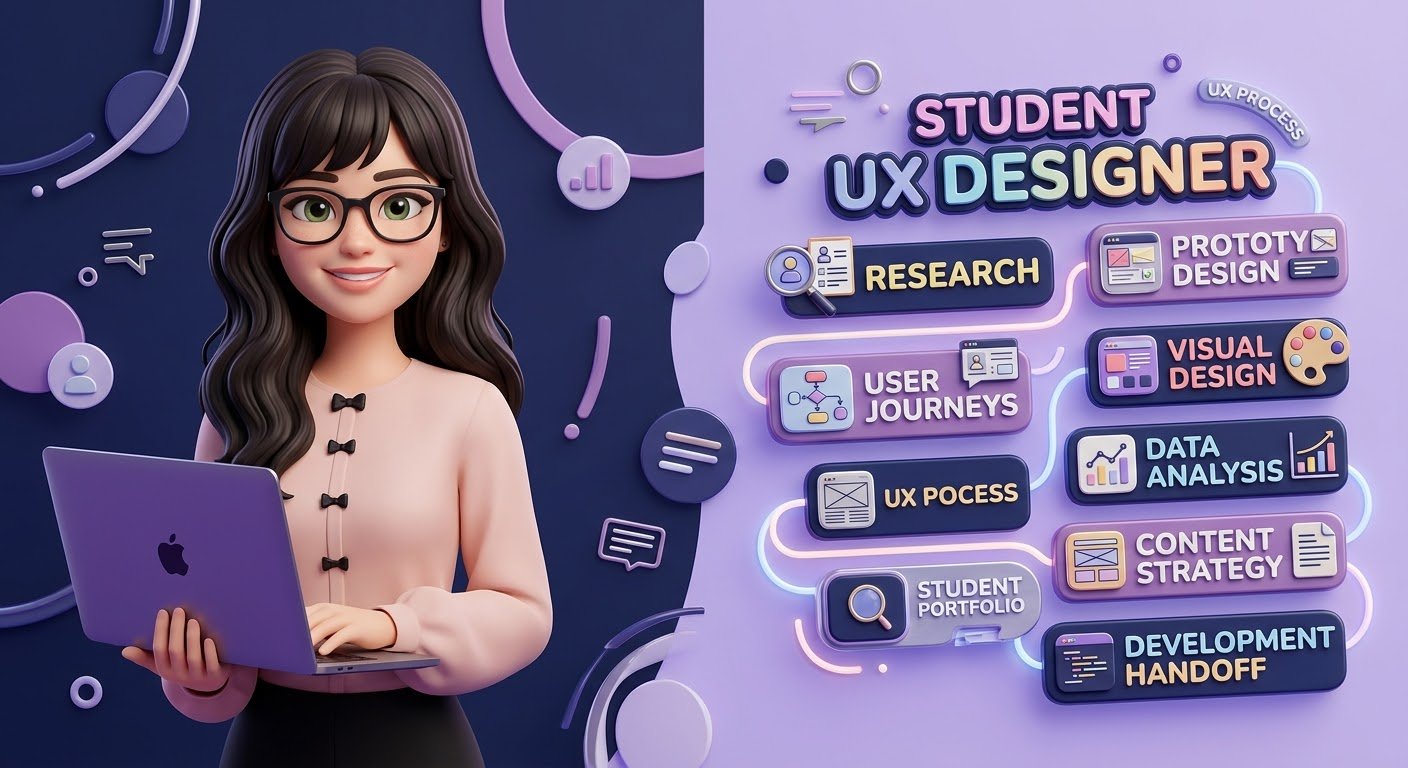
Design isn't just about wireframes—it's about business and psychology.
UX Tools For Beginners
UX For Beginners is your proven roadmap from theory to your first job.
Here's how this department revolutionizes getting started in the industry and supports young designers in every steps of their journey.
Design
tools
craft
art
and
Master the basics of UX with our free compendium.
- Understanding theory and human behavior design is not only about arranging blocks on the screen, but above all psychology. This section teaches how users’ cognitive mechanisms work, providing a solid theoretical foundation based on the literature.
- Practical Skills Development: Say goodbye to expensive, low-value courses. With proven tutorials and webinars, you’ll master key research tools and processes step by step, building strong technical competencies.
- Track trends and gain first-hand knowledge: Gain direct insight into how the industry is changing dynamically (including the implementation of AI tools), learning from practitioners from around the world.
- Business Approach to Design: The most common mistake junior designers make is failing to understand the client’s business goals. This section teaches you how to speak the language of business, how to justify your design decisions, and how to demonstrate the value of your work to management.
- Smooth entry into the job market: Once you’ve mastered the basics, the job offers section will help you find your first commercial challenges or internships, connecting your new skills with the real needs of employers
Potential Future Tools That You Should Know
Education Means Everything



Analysis & Define Tools
Before a single line of code or pixel appears on a screen, you need to understand the problem. This section brings together advanced tools for analyzing quantitative and qualitative data and mapping user needs. Learn how to transform raw data into precise personas, empathy maps, and user journeys. Start with facts, not guesswork.
Collaboration Tools & Copyright UX Tools
Design is a team sport. We present platforms that connect the work of designers, developers and clients in real time. Thanks to them, you eliminate misunderstandings, collect feedback in one place and take care of the legal and copyright aspects of your projects. Work smarter, communicate faster.
Design Tools for UX, Design Systems & Prototyping
Your ideas deserve perfect form. Discover an ecosystem of tools for creating lo-fi and high-fidelity mockups, interactive prototypes, and scalable design systems. Here, you'll learn to design repeatable components that developers will love, bringing your mockups to life before you even start coding.
Generative AI Tools
The future of design is happening now. This section is your tech booster—a suite of generative AI tools that automate repetitive tasks. From generating page layouts, to intelligent content completion (copywriting), to instantly transforming sketches into finished components. Design at the speed of AI.
The foreign market values specialists based on hourly rates or fixed monthly contracts. The values represent average rates on foreign European B2B contracts in the 2026/2027 season
Job salary calculator for UX Designer 2026/2027 year
Average hourly rate for Freellance
Forms of Employment in IT/Design What Pays the Most?
The form of employment you choose has a key impact on how much of the negotiated amount you actually end up with. In the digital design industry, the three most popular paths are B2B (Sole Proprietorship), Employment Contract (UoP), and Contract for Specific Work (with copyright).
1. B2B Contract (VAT Invoice) – Maximum earnings and flexibility. This is the absolute standard for Mid- and Senior-level professionals. It involves providing services as an independent company.
- 👍 Advantages: The lowest taxes (especially at a flat rate of 8.5% for designers or 12% for developers), the ability to pass on costs to the company, ease of settlement with foreign clients in EUR/USD.
- 👎 Challenges: No paid vacation or sick leave (unless you negotiate so-called paid days off in your contract), having to pay social security contributions and accounting yourself.
2. Contract for Specific Work with 50% KUP (Costs of Obtaining Income) – Ideal for Freelancers. A form dedicated to pure creative work (e.g. UI design, illustrations, icons, unique code), which involves the transfer of copyrights.
- 👍 Advantages: Very high net income thanks to the 50% deduction of income-earning costs. No social security contributions (if this is your only source of income).
- 👎 Challenges: Lack of continuity of employment, lack of labor code protection, more difficult path when applying for a mortgage loan.
3. Employment Contract (UoP) – Maximum security. A classic full-time position most often chosen by people starting their careers (Junior) and people who value full stability.
- 👍 Advantages: Paid vacation leave (20 or 26 days), stable notice period, full health insurance, highest credibility with banks.
- 👎 Challenges: The highest tax and contribution burden (the smallest net amount from the employer’s budget), no possibility of legally settling business costs.
💡 Why will multidisciplinarity dictate pay in the 2026/2027 season?
- The traditional division of roles is becoming fluid. The most sought-after specialists in the digital services market are currently so-called T-shaped professionals – individuals with deep knowledge in their niche (e.g., UX Research) but with the ability to navigate related areas, such as generative AI tools, basic web development (App Building), or technical SEO. The uxdesignerslife.com platform provides a complete set of tools for each of these pillars, enabling rapid improvement in skills and earnings.

- Ask one key question during the interview: Instead of asking about benefits, ask: “How does the company measure the success of implemented digital products, and how will my team be held accountable for achieving business goals?” This immediately positions you as a high-level expert.
Tips: How to negotiate and increase your earnings in 2026/2027?
The introduction of AI automation has changed the pay structure – the market now pays the most to multidisciplinary specialists who can drive business goals. Here's how to truly increase your market value:
- Speak the language of business: Don’t sell customers “pretty screens.” Show them how your UX research will reduce cart abandonment or how development optimization (Core Web Vitals) will lower hosting costs and increase conversions.
- Implement AI tools into your workflow: A designer or developer who can use AI to reduce work time on repetitive tasks by 50% is an extremely profitable employee for the company. Instead of hiding your AI use, showcase it as a technological advantage.
- Build a process-based portfolio (case studies): Juniors often only show the finished product. Employers are looking for people who can document the process: from generating a research hypothesis, through usability testing, to code implementation.
FAQ Questions Future UX Designer Ask
To successfully launch a career in UX, you need to combine the study of human behavior psychology with practical knowledge of tools and business. The uxdesignerslife.com platform, in its UX For Beginners section, aggregates free tutorials, recommended books, courses, and webinars that systematize this knowledge and help you get started from scratch.
No, artificial intelligence won't replace designers, but it will automate their routine work. A modern UX designer leverages AI tools (available in the Generative AI Tools section) for rapid prototyping and data analysis, freeing up time for strategy, empathy, and business acumen.
Once you've mastered the theoretical and technical foundations, it's worth following selected job offers in the Job Offers section on uxdesignerslife.com. The key to getting hired is showcasing projects based on real user research (Research & Testing) in your portfolio.
Most foreign companies cooperate with Polish specialists exclusively on the basis of B2B contracts ( Independent Contractor Agreements). To safely and legally settle foreign rates in euros, Polish designers most often choose the flat-rate tax, registering as EU VAT payers. The uxdesignerslife.com platform facilitates multidisciplinary development, allowing them to freely compete in the international remote work market.